History & Classical Themes — GPT Image 2 prompt template
History & Classical Themes · History · Classical · Scroll
Historical and classical subjects with the period fixed: dynasty, clothing system, object references, layout format and cultural mood.
Dynasty clothing, scroll narrative, poetry, and traditional motifs. It fits cultural content, book and album art, museum-adjacent illustration and anything where a hand-wave at "ancient" would look wrong to a reader who knows the period.
When to use it
Use for ancient Chinese themes, scrolls, dynasty clothing, poetry visuals, and historical scenes. It sits in the History & Classical Themes group of the catalog, which covers classical scrolls, historical figures, traditional themes, and poetry visuals. If your brief is closer to one of the neighbouring genres, the related templates at the bottom of this page are the faster route — picking the right template matters more than perfecting the wrong one.
The template
Copy the block, replace everything inside brackets with your own specifics, and delete any line that does not apply to your brief. The template text is published in Chinese, as it appears in the upstream catalog; the structure is what carries the value, so translating the labels into your own language changes nothing about how it works.
生成[朝代/古风设定]题材画面,主题为[主题]。
人物:[身份/服饰/器物],场景:[宫廷/市井/山水]。
美术风格:[工笔/写意/影视写实],色调:[色调]。
文化细节:[纹样/礼制/建筑要素]。
输出:历史氛围准确的古风题材图。
JSON version (agent-friendly)
Every History & Classical Themes template shares one JSON block, which expresses the same kind of decisions as key–value fields rather than prose. Use it when a script, an agent or a form fills in the values, or when you want to change a single field between runs and see exactly what changed; swap the example values for your own.
{
  "type": "Historical/Oriental Scene",
  "setting": "Tang Dynasty Capital City at Night",
  "subject": {
    "identity": "Noblewoman",
    "clothing": "Traditional Ruqun (襦裙) with elaborate floral embroidery",
    "action": "Holding a glowing silk lantern, looking at fireworks"
  },
  "style": "Cinematic realism combined with subtle traditional ink wash (水墨) textures",
  "details": "Accurate Tang architecture, bustling crowd in background",
  "constraints": "No modern elements, historically accurate clothing structure"
}
How to fill it in
The block above asks you to make 7 explicit decisions before you send anything. That is the point of a template: the decisions you do not make are made for you, and in image generation the defaults are what produce work that looks generic.
Name the dynasty or period and the clothing system that goes with it, and cite the object references you want present. Specificity is the whole value of this block.
Choose the format on purpose — a hanging scroll, an album leaf, a poster — because each one implies a different aspect ratio, margin treatment and reading order.
- Specify dynasty, clothing system, object references, layout format, and cultural mood.
- Use scroll, album page, or poster format deliberately.
A working order for the whole thing: fill the structural slots first (subject, layout, format), then the visual ones (palette, light, material), then the text that has to appear verbatim, and only then the mood words. Run it once, change one field, run it again — a template you iterate one variable at a time tells you which variable did the work, which a rewritten prompt never does.
Common mistakes
Mixing periods is the error that a knowledgeable audience notices immediately: garments from one era, architecture from another, props from a third.
Modern objects drift in unless they are ruled out, and a single contemporary item can undo an otherwise careful historical frame.
- Avoid mixing dynasties when historical accuracy matters.
- Constrain random modern props.
Example results
These are the public posts this template was distilled from: the creator shared the image and the prompt behind it, and the recurring structure across cases like these became the block above. Each card links back to its source, and a public post is not a licence to reuse the image.
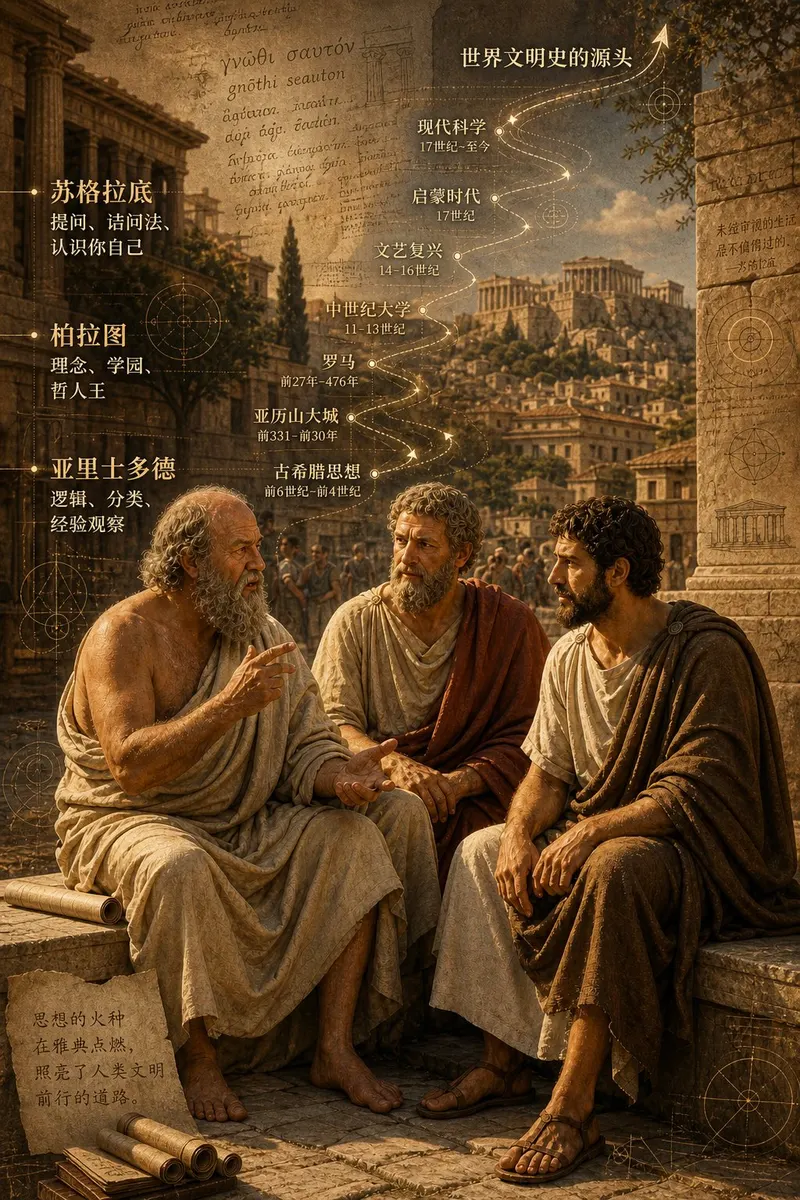
古希腊三哲时间轴城市图
二千五百年前,柏拉图,苏格拉底, 亚力士多德,坐在雅典街头聊天,聊出了世界文明史的源头。 背景可以加上他们聊天内容,按时间轴的走向,重叠在古希腊雅典的城市风光中。
Red Cliff Classical Scroll
帮我生成一张《赤壁怀古》的长卷图,带整篇《赤壁赋》文字

Related templates
- Document & Publishing — White papers, manuals, encyclopedic plates, and page systems.
- Concept Product Breakdown — R&D boards, exploded views, mixed tasks, and special outputs.
- UI Screenshot System — High-fidelity app, web, dashboard, and social interface prompts.
- Infographic Engine — Structured diagrams, timelines, knowledge maps, and explainers.
- Scientific Scale Diagram — Multi-scale science visuals with readable labels and hierarchy.
Frequently asked questions
- How accurate are the historical details?
- As accurate as the prompt makes them. The block gives you slots for dynasty, clothing and object references precisely because unspecified periods blend; check the result against a source if accuracy matters.
- Does the scroll format change the composition?
- Substantially. A scroll implies a long format read along its length, an album leaf implies a bounded page, and a poster implies a single focal composition — pick the one your output needs to live in.
- Is the History & Classical Themes template free to use?
- Yes. The template text comes from the open-source awesome-gpt-image-2 catalog by freestylefly, published under the MIT licence, and PicGens reproduces it with credit. Copy it, fill in the brackets and paste it into whichever tool you run GPT Image 2 in.
- What is the JSON version of the template for?
- It carries the same decisions as key–value fields instead of prose, which is easier for an agent or a script to assemble programmatically and easier to diff when you iterate. Use the plain-text block when you are writing by hand and the JSON block when something else is filling in the values.
- Where do the example results come from?
- They are public posts by creators who shared both the image and the prompt behind it, collected in the same open catalog. Each one links back to its source, and a public post is not itself a licence to reuse the image.
中文说明
历史与古风题材 — 生成朝代服饰、长卷叙事、诗词和传统题材。
用于古风题材、长卷、朝代服饰、诗词视觉和历史场景。
- 指定朝代、服饰制度、器物参考、版式和文化气质。
- 明确长卷、册页或海报形式。
- 需要历史准确时,避免朝代混搭。
- 约束随机现代物件。
Keep exploring
Template text and case metadata from awesome-gpt-image-2 by freestylefly, used under the MIT licence. English commentary by PicGens. Results vary by model version, reference image and settings.